

Unifying data structures across diverse industries, ranging from automotive giants to e-bike manufacturers, presents a unique challenge. To ensure these distinct sectors can collaborate effectively, the RAASCEMAN project has focused on establishing a shared digital language. Through Work Package 2, the consortium has built a robust semantic backbone that bridges technical boundaries, ensuring that data is interpreted consistently by all partners.
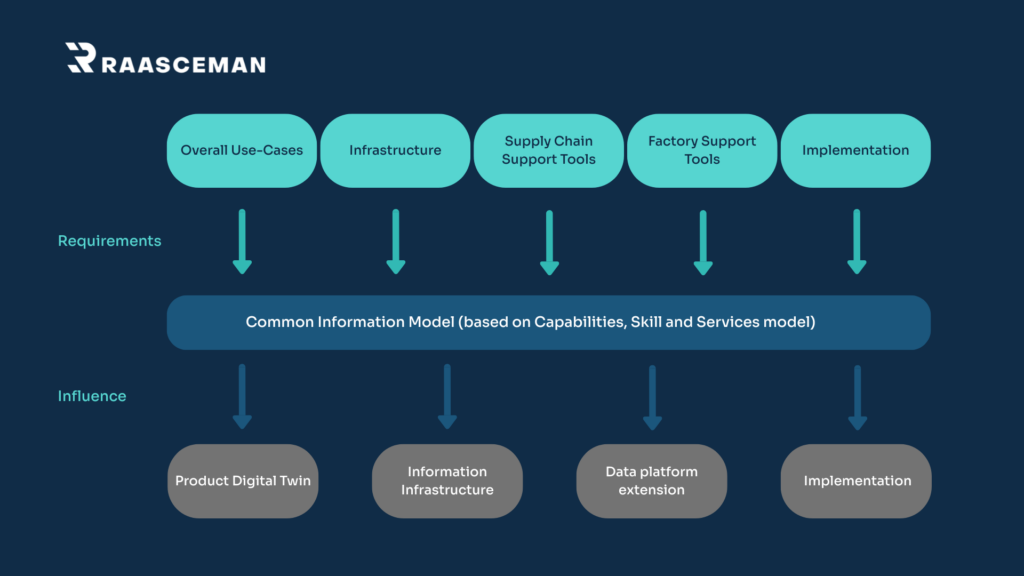
Within the RAASCEMAN project, Work Package 2 played a crucial role in standardizing communication within a diverse consortium. The partners came from different industries, including automotive and e-bikes, as well as several adjacent domains, each with its own terminology and data structures. Task 2.1 aimed to address this issue by establishing a shared language for exchanging information within the Asset Administration Shell (AAS), which is a set of models that ensure consistent data interpretation.
To achieve this, the team started by mapping existing standards from the Industrial Digital Twin Association (IDTA), reusing established submodels wherever possible rather than reinventing them. For the gaps that remained, the consortium developed new submodels tailored to RAASCEMAN’s needs. Together, these models now provide a common semantic backbone for the entire project, enabling seamless collaboration across technical and industrial boundaries.
Open Access to Research Results
As part of the RAASCEMAN project, all public reports are being made openly accessible via the Zenodo platform, which is operated by the European Commission. This means that project partners, as well as researchers and industry stakeholders across Europe and beyond, can benefit from the material.
In Deliverable 2.1, the team conducted a detailed analysis of requirements to determine which information sub-models could be adopted directly from the IDTA framework and which needed to be created specifically for RAASCEMAN. Certain elements, such as the Manufacturing Bill of Services, required custom development and will evolve as the project progresses.
The report provides a transparent explanation of the reasoning behind these choices, offering readers insight into how the consortium determined what to reuse and what to develop. All of this knowledge is freely available online, in line with the European Commission’s open-access policy.